
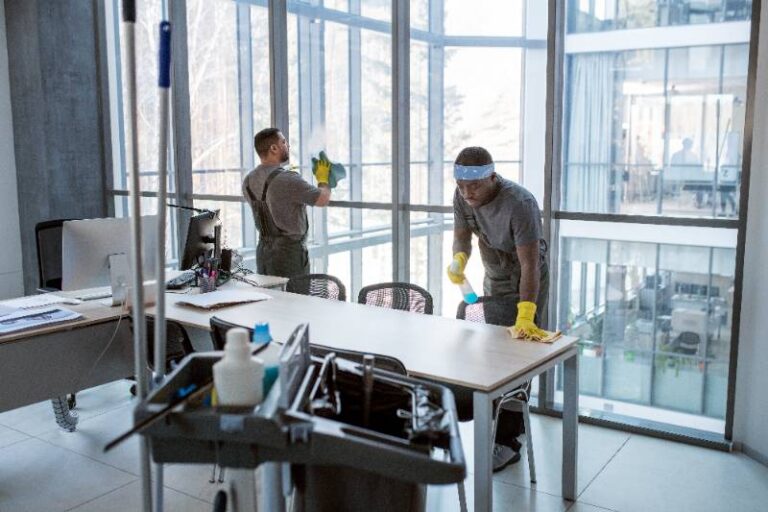
A standard commercial cleaning service typically includes trash removal, restroom sanitation, surface disinfecting, floor care (vacuuming and mopping), dusting, and supply restocking — performed on a recurring schedule, usually nightly or several times per week. Beyond this core scope, most providers offer add-on services like carpet deep cleaning, window washing, and day porter support for an additional fee or as part of a customized plan. What’s actually included varies by provider and contract, which is why it’s worth knowing exactly what to ask before signing.
If you’re evaluating commercial cleaning proposals and trying to compare what one company’s “full-service cleaning” actually covers versus another’s, this guide breaks down the real scope of work — task by task.
Key Takeaways
Core janitorial service covers trash removal, restroom cleaning, surface disinfecting, floor care, and dusting — done on a recurring schedule.
Day porter service is a separate, often add-on offering that provides continuous daytime attention to high-traffic areas like lobbies and restrooms.
Specialty services — carpet cleaning, window washing, pressure washing, floor stripping/waxing — are typically scheduled separately from daily janitorial work.
Scope of work should be spelled out in writing, ideally with a task checklist and frequency, not just a vague “we’ll keep it clean” promise.
Facility size and type change the scope. A medical office and a standard corporate office have different standard task lists.
Ask what’s NOT included — this is often where surprise costs or gaps in service show up.
What’s Included in Standard Commercial Cleaning?
The core scope of most commercial cleaning contracts typically includes several recurring task categories, although the exact services can vary depending on the facility and cleaning provider. Trash removal generally includes emptying and relining bins throughout offices, break rooms, and restrooms.
Restroom sanitation involves disinfecting fixtures, cleaning and mopping floors, and restocking essential supplies. Surface cleaning typically covers wiping and disinfecting desks, counters, tables, and frequently touched surfaces to help maintain a hygienic workplace.
Floor care includes vacuuming carpets as well as sweeping and mopping hard-surface floors. Dusting generally covers accessible surfaces, ledges, furniture, and other areas within normal reach. Supply restocking is another common responsibility and may include replenishing paper towels, toilet paper, hand soap, and trash liners. Together, these recurring services help maintain a clean, presentable, and sanitary commercial environment.
Why “Full-Service Cleaning” Doesn’t Always Mean the Same Thing
Two providers can both advertise “full-service commercial cleaning” and mean very different things by it. One company’s standard scope might include high dusting and interior glass, while another treats those as add-ons. This is why a written, itemized scope of work matters more than a general marketing phrase — it’s the only way to compare providers accurately and avoid gaps once service begins.
What’s the Difference Between Janitorial Service and Day Porter Service?
Janitorial service typically happens after hours or during off-peak times and covers the full facility on a set schedule (nightly, several times a week, etc.). Day porter service is a separate offering that provides continuous, on-site attention to high-traffic areas throughout the business day — think lobbies, restrooms, break rooms, and entryways that need repeated touch-ups rather than a single nightly pass.
When Does a Facility Need Day Porter Service?
Day porter service is most valuable for buildings with:
High visitor or foot traffic throughout the day
Restrooms that need multiple checks, not just one nightly cleaning
Public-facing lobbies or entryways that need to stay presentable during business hours
Special events requiring on-site cleanup support before, during, or after
Facilities like medical offices, large corporate campuses, and multi-tenant buildings often pair standard nightly janitorial service with a day porter for continuous daytime coverage.
What’s Usually Considered a Specialty or Add-On Service?
Certain services fall outside standard recurring janitorial work and are typically scheduled separately — often monthly, quarterly, or seasonally:
Carpet cleaning and flood restoration — deep extraction cleaning, stain removal, and water damage restoration.
Hard surface floor care — stripping, waxing, and polishing for VCT, tile, concrete, and terrazzo floors.
Window washing — interior and exterior glass cleaning.
Pressure washing — exterior walkways, entryways, and parking areas.
Special event cleanup — pre- and post-event cleaning, trash removal, and restocking for corporate events or meetings.
These services are often bundled into a broader facility care plan so a business can schedule everything through a single provider rather than juggling multiple vendors.
Top 5 Questions Businesses Ask About Commercial Cleaning Scope
1. What is typically NOT included in standard commercial cleaning?
Most standard janitorial contracts exclude deep carpet extraction, interior/exterior window washing, floor stripping and waxing, and pressure washing unless specifically added to the contract. High-reach dusting (above normal reach) and detailed appliance cleaning inside break room equipment are also commonly excluded from base service. Always confirm these details in writing before signing.
2. How often does commercial cleaning happen?
Frequency depends on the facility’s size, traffic, and industry — most active offices are cleaned 2-3 times per week to daily, while high-traffic or medical facilities often require daily service. Specialty services like carpet cleaning are typically scheduled quarterly or semi-annually rather than as part of the recurring visit.
3. Can commercial cleaning scope be customized per facility?
Yes. Reputable providers evaluate building layout, traffic patterns, and industry-specific needs before building a task list, rather than applying a generic template. A medical office, for example, needs different disinfection protocols than a standard corporate office, and a large multi-tenant building needs a different cleaning strategy than a small single-tenant space.
4. What should be included in a commercial cleaning contract or scope of work?
A solid contract should clearly spell out:
The specific tasks included (not just general categories)
Frequency for each task or area (nightly vs. weekly vs. monthly)
Which areas are covered vs. excluded
Who to contact for service issues or additional requests
Whether supplies (toilet paper, soap, liners) are included or billed separately
5. Does commercial cleaning include restocking supplies like toilet paper and soap?
Most standard janitorial contracts include restocking of basic consumables — toilet paper, paper towels, hand soap, and trash liners — as part of routine service. However, the cost of the supplies themselves is sometimes billed separately or requires a jan-san supply arrangement, so it’s worth clarifying this upfront.
Common Mistakes and Misconceptions About Commercial Cleaning Scope
“Full-service means everything is included.” As covered above, marketing language varies widely between providers — always request an itemized scope.
“One cleaning plan fits all facility types.” A restaurant, medical office, and corporate office all have different baseline requirements; a generic package often leaves gaps.
“Day porter and janitorial service are the same thing.” They serve different purposes — nightly janitorial covers the whole facility, while day porter service handles continuous daytime upkeep of high-traffic zones.
“Specialty services are automatically included.” Carpet cleaning, window washing, and floor waxing are almost always scheduled and priced separately from routine janitorial work.
“Cheaper bids always mean less service.” Price differences often come down to scope, not just quality — a lower bid may simply exclude tasks a higher bid includes. Compare scope line by line, not just the total price.
Expert Tips for Evaluating a Commercial Cleaning Proposal
Ask for a written, itemized task list — not just a general description like “full-service cleaning.”
Confirm frequency for every category, not just an overall visit schedule. A weekly visit that includes daily restroom service is different from one that doesn’t.
Clarify what’s excluded, not just what’s included. Gaps in service usually show up in what wasn’t discussed upfront.
Ask about supply restocking and who provides it. This is a common area of confusion between clients and providers.
Request references or reviews from similar facility types. A provider experienced with medical offices may not have the same expertise in industrial or multi-tenant properties.
Look for a single provider who can bundle specialty services. Managing carpet cleaning, floor care, and window washing under one contract (rather than separate vendors) simplifies scheduling and accountability.
Conclusion
“Commercial cleaning” covers a wide range of possible tasks, and what’s actually included depends entirely on the provider and the contract. At its core, most standard janitorial service includes trash removal, restroom sanitation, surface disinfecting, floor care, dusting, and supply restocking — with specialty services like carpet cleaning, window washing, and floor care typically scheduled separately. The best way to avoid gaps in service is a written, itemized scope of work built around your specific facility rather than a generic package.
Sonlight Cleaning has served Dallas-Fort Worth businesses for over 39 years, building customized janitorial and facility care programs for offices, medical facilities, and multi-tenant properties across Dallas, Fort Worth, Plano, Arlington, and the surrounding metroplex.
Get a Custom Scope of Work for Your Facility
Not sure exactly what your facility needs included in its cleaning plan? Request a free quote and facility walkthrough from Sonlight Cleaning. Our team will build a clear, itemized scope of work based on your building’s layout, traffic, and industry — so you know exactly what’s covered before you sign.
What does a typical commercial cleaning checklist include?
A typical checklist includes trash removal, restroom sanitation, surface disinfecting, vacuuming/mopping, dusting, and supply restocking, performed on a recurring schedule based on the facility’s size and traffic.
Is carpet cleaning included in regular janitorial service?
Typically no — daily janitorial service usually includes vacuuming, while deep carpet extraction and stain removal are scheduled as a separate service, often quarterly or semi-annually.
Does commercial cleaning include window washing?
Interior surface wiping (like glass office partitions) may be part of standard service, but full interior and exterior window washing is usually a separate offering.
What's included in hard surface floor care?
Hard surface floor care typically includes cleaning, stripping, waxing, and polishing for VCT, tile, concrete, and terrazzo flooring — usually scheduled separately from daily janitorial visits.
Can a single provider handle both daily janitorial and specialty services?
Yes — many facilities prefer working with one provider who can bundle daily janitorial service with specialty offerings like carpet cleaning, floor care, window washing, and pressure washing, simplifying scheduling and communication.